FIFA World Cup 2026 Champions: How Spain Conquered the World Again

Sixteen years. That is how long Spain waited between world titles. On Sunday night in East Rutherford, New Jersey, the wait ended.
Spain beat Argentina 1-0 after extra time in the FIFA World Cup 2026 final, and Ferran Torres wrote his name into Spanish football history with the winning goal in the 106th minute. In front of a crowd of more than 80,000 at MetLife Stadium, captain Rodri lifted the trophy that Iker Casillas last raised for La Roja in Johannesburg in 2010.
This was not a lucky run. Spain conceded one goal in eight matches. One. No world champion in the history of the tournament had ever done that. They dismantled France in the semifinal, shut out Portugal, survived Belgium, and then suffocated the defending champions so completely that Argentina failed to register a single shot on target across 120 minutes of the final.
It also closed a chapter. Lionel Messi, playing what he had said would be his final World Cup, walked past the trophy one last time with a silver medal around his neck. A tournament that began with 48 teams across three host nations ended with the game's most complete team holding the game's biggest prize.
This is the full story of the FIFA World Cup 2026 champions: how Spain got there, how they played, who delivered, what the numbers say, and where this triumph sits in football history.

Tournament Overview: A World Cup Unlike Any Other
The First 48-Team World Cup
The 2026 FIFA World Cup broke the mold before a ball was kicked. For the first time, 48 nations competed at the finals, up from the 32-team format that had defined the tournament since 1998. Twelve groups of four fed into a brand-new round of 32, meaning the champion would have to win eight matches instead of seven — see our complete FIFA World Cup 2026 guide for the full format, host cities and qualified teams.
The expansion created real stories. Cape Verde, the smallest nation ever to reach a World Cup knockout stage, drew all three of their group matches on debut and advanced. Established powers had less margin for error, and the extra knockout round punished any team that arrived undercooked.
It also raised a legitimate question: would the bigger format dilute quality? By the final week, the answer was clear. The last four — Spain, Argentina, France and England — represented the strongest collection of semifinalists in recent memory.
Three Hosts, One Continental Stage
The United States, Mexico and Canada shared hosting duties, spreading matches across cities from Vancouver to Guadalajara to Miami. It was the first World Cup staged by three nations, and the scale was enormous: sixteen host cities, continental travel distances, and everything from the altitude of Mexico City to summer heat on the American East Coast.
For the hosts themselves, the tournament ended in shared heartbreak. All three co-hosts reached the round of 16, and all three fell there — Canada to Morocco, Mexico to England, and the United States to Belgium. The party continued without them, but the stadiums stayed full. The final alone drew more than 80,000 to MetLife Stadium.
How the Final Was Set
The bracket delivered a final worthy of the buildup. Argentina, world champions in 2022, fought through a string of dramatic knockout wins, including a stoppage-time semifinal winner against England sealed by Lautaro Martínez with Messi assisting both goals. Spain took the opposite route: control, clean sheets, and a 2-0 semifinal dismantling of France that never looked in doubt.
Grit against control. The old king against the new order. Messi's farewell against Lamine Yamal's arrival. The storylines wrote themselves, and for once, the match lived up to them.

Spain Before the Tournament: Champions With a Point to Prove
European Champions Arriving in Form
Spain did not sneak up on anyone. They arrived in North America as reigning European champions and one of the pre-tournament favorites, with a settled identity under head coach Luis de la Fuente and a qualifying campaign that bordered on ruthless — including a 6-0 demolition of Türkiye away from home and clean sheets stacked on clean sheets.
But favorites' tags had burned Spain before. Between the 2010 triumph and this tournament, La Roja had gone through four World Cups without winning a single knockout match. The 2014 title defense collapsed in the group stage. Russia 2018 and Qatar 2022 both ended in penalty-shootout exits to the host nation and Morocco respectively. The talent was never in question. The tournament pedigree was.
De la Fuente's Euro 2024 title changed the mood, but a World Cup is a different animal. This squad traveled with one job: prove that the European crown was the start of an era, not the peak of one.
The Squad Selection
De la Fuente named a 26-man squad that blended youth and established quality. Barcelona's Lamine Yamal, still a teenager when the squad was announced, was included for his first World Cup. Paris Saint-Germain's Fabián Ruiz arrived fresh from winning the Champions League. An Arsenal trio of David Raya, Martín Zubimendi and Mikel Merino added Premier League steel, and Manchester City's Rodri — the reigning Ballon d'Or winner and the team's captain — anchored everything.
The most debated calls came in midfield and attack. De la Fuente showed throughout the tournament that he would pick function over fame, and his willingness to leave Pedri on the bench for big matches, including the final, became one of the defining selection stories of the summer. It drew criticism at the time. It looks like conviction now.
Expectations and Pressure
Spanish football entered the summer in a position of extraordinary strength. The women's national team held the Women's World Cup and a number-one world ranking. The men held the European Championship. A men's world title would make Spain the first nation ever to hold both World Cups at the same time.
That was the weight on this squad's shoulders in June. By July 19, it was history.

Group Stage: Slow Start, Ruthless Finish
Spain were drawn into Group H alongside Uruguay, Saudi Arabia and tournament debutants Cape Verde. On paper, a group they should win. On grass, it started with a warning.
Spain 0-0 Cape Verde (June 15, Atlanta)
The opener in Atlanta was the kind of match that launches a thousand hot takes. Spain monopolized the ball against a Cape Verde side making their World Cup debut, and found nothing. The debutants defended their box with discipline, celebrated the final whistle like a victory, and left Spain facing questions about whether the old ghosts — all possession, no punch — had followed them across the Atlantic.
In hindsight, the draw said more about Cape Verde than Spain. The island nation went on to draw all three group matches and reach the round of 32, the smallest country ever to make a World Cup knockout stage. At the time, though, the Spanish press wanted answers.
Spain 4-0 Saudi Arabia (June 21, Atlanta)
The answer came six days later on the same pitch. Spain tore through Saudi Arabia 4-0 in a performance that flipped the narrative overnight. The movement was sharper, the final ball cleaner, and the gap between the sides brutal. One match into the tournament, Spain had looked blunt. Two matches in, they looked like the team that had swept through qualifying.
The clean sheet mattered too. It was the start of a defensive pattern that would define the entire campaign.
Uruguay 0-1 Spain (June 26, Guadalajara)
The group decider took Spain to Mexico, and to their toughest group examination. Uruguay needed a result to survive; Spain needed one to win the group and avoid a harder side of the draw. In a tense, physical match at altitude, Spain edged it 1-0.
It was not a spectacle. It was something more valuable: a tournament win in a knife-edge game against a desperate South American opponent. Uruguay, with just two points, were out — one of the shocks of the group stage. Spain topped Group H with seven points and had still not conceded a goal.
Group H Final Standings
| Pos | Team | P | W | D | L | GF | GA | Pts | Result |
|---|---|---|---|---|---|---|---|---|---|
| 1 | Spain | 3 | 2 | 1 | 0 | 5 | 0 | 7 | Advanced as group winners |
| 2 | Cape Verde | 3 | 0 | 3 | 0 | 2 | 2 | 3 | Advanced as runners-up |
| 3 | Uruguay | 3 | 0 | 2 | 1 | 3 | 4 | 2 | Eliminated |
| 4 | Saudi Arabia | 3 | 0 | 2 | 1 | 1 | 5 | 2 | Eliminated |
Spain Group Stage Match Results
| Date | Match | Score | Venue |
|---|---|---|---|
| June 15, 2026 | Spain vs Cape Verde | 0-0 | Atlanta |
| June 21, 2026 | Spain vs Saudi Arabia | 4-0 | Atlanta |
| June 26, 2026 | Uruguay vs Spain | 0-1 | Guadalajara |
Three matches. Seven points. Five goals scored, zero conceded. And still, almost nobody outside Spain was calling them the team to beat. Argentina's star power, France's depth and England's attacking form dominated the conversation.
The knockout rounds were about to change that.


Round of 32: Spain 3-0 Austria — Sixteen Years of Waiting Ends
July 2, Los Angeles. Spain walked into the first knockout round carrying a statistic that had haunted them for over a decade: they had not won a World Cup knockout match since the 2010 final itself. Four tournaments. Zero knockout victories. Austria, who had battled through a group featuring Argentina, were no pushovers.
For half an hour, the old anxiety flickered. Marc Cucurella had a goal disallowed after Pau Cubarsí was judged to have fouled Austrian goalkeeper Alexander Schlager at a corner. Then, in the 36th minute, the dam broke. Cucurella drove down the left and delivered a low cross, and Mikel Oyarzabal side-footed it into the bottom corner.
From there, Spain played with a freedom they had not shown in a World Cup knockout tie in sixteen years. Pedro Porro made it 2-0 in the 66th minute, arriving at the far post to head in Álex Baena's cross from six yards. Oyarzabal added his second in the 89th, running onto another Cucurella pass and finishing low from twelve yards.
Why This Match Mattered More Than the Scoreline
Austria did not manage a single shot on target. During this match, Unai Simón surpassed the all-time World Cup record for consecutive scoreless minutes by a goalkeeper — a mark of 517 minutes held by Italy legend Walter Zenga since 1990. Simón's streak stretched back to the group stage of Qatar 2022, carried through Spain's clean-sheet group campaign, and was still growing.
The tactical pattern was set here too: full-backs as attacking weapons. Cucurella created two goals from the left, Porro scored from the right. Teams that packed the middle against Spain would spend the rest of the tournament being pulled apart from the flanks.

Round of 16: Portugal 0-1 Spain — Merino Breaks Ronaldo's Heart
The Iberian derby, on the biggest stage, for only the third time in World Cup history. July 6 in Arlington, Texas brought together two European heavyweights meeting for the 42nd time overall — and it carried an unavoidable subplot. Cristiano Ronaldo, aged 41, had said this would be his final World Cup. See our full Round of 16 fixtures and results for how the rest of the bracket played out.
It was a grind, and an honest report has to say so. The first half produced shots but no cutting edge. Oyarzabal pulled his effort wide after Dani Olmo released him clean through, and Diogo Costa tipped Baena's curler around the post. Simón was worked twice at the other end. Only Ronaldo's two attempts, of Portugal's ten shots all game, found the target.
Roberto Martínez had gambled with his lineup, starting João Félix ahead of Rafael Leão on the left. Portugal stayed compact, defended well, and late on nearly stole it — Bernardo Silva flicked a header onto the roof of the net from Francisco Conceição's cross, then João Neves sent a diving header agonizingly wide from a Bruno Fernandes delivery.
The Winning Moment
Spain's answer came from the bench, and it defined their tournament. In the first minute of second-half stoppage time, substitute Mikel Merino was fouled, took the free kick quickly himself, kept running, and collected Ferran Torres's return pass before firing past Costa. One moment of alertness in a match of attrition, and Spain were through.
The cameras found Ronaldo at full time, in tears, his World Cup career almost certainly over without the one trophy missing from his collection. For Spain, the win carried its own history: their first World Cup quarterfinal appearance since lifting the trophy in 2010. According to FotMob's tracking data, Spain generated 1.77 expected goals from 15 shots against Portugal's 0.60 — a fair reflection of a tight game Spain just about deserved.
There was a record too. The clean sheet gave Spain the most consecutive World Cup matches without conceding in tournament history, breaking a tie with Italy's 1990 side and Switzerland's 2006-10 run.


Quarterfinal: Spain 2-1 Belgium — The Only Goal They Conceded
Back to Los Angeles on July 10, and the first genuine crisis of Spain's tournament. Belgium arrived in their first quarterfinal since 2018 already wounded — captain Youri Tielemans was injured in the warmup and never started — but they gave Spain their hardest ninety minutes of the summer.
Luis de la Fuente sprang another selection surprise, starting Fabián Ruiz, and it paid off inside half an hour. Ruiz slotted home a rebound in the 30th minute for 1-0. Then, in the 41st minute, something happened that no team had managed all tournament: Charles De Ketelaere equalized, and Spain had conceded a World Cup goal.
It would be the only one, all summer. But nobody knew that in Los Angeles, with the score level and Belgium growing into the game.
Chaos, Injuries and a Late Winner
The second half swung end to end. Belgium lost Thibaut Courtois to injury, sending backup goalkeeper Senne Lammens into a World Cup quarterfinal cold. Lamine Yamal and Oyarzabal tested both keepers. At the other end, Unai Simón survived a genuine scare when he raced off his line and Aymeric Laporte had to clear a dangerous Belgian cross.
Then, for the second match running, De la Fuente reached for Merino — and for the second match running, Merino won it. Less than two minutes after coming on, he turned home the rebound after Lammens spilled Pau Cubarsí's close-range shot. Eighty-eighth minute. 2-1. Spain held out for ten more minutes and were in their first World Cup semifinal since 2010.
FIFA's official match statistics showed the underlying control: 61 percent possession to Belgium's 30, seventeen attempts to five, eight on target to two. ESPN's data put Spain's expected goals at 2.08 against Belgium's 0.38. Spain had been pushed harder than the scoreline of any of their other matches suggested — and had found a way anyway. Champions tend to have one match like this. This was Spain's.

Semifinal: France 0-2 Spain — The Statement Performance
If the Belgium match was Spain's survival test, the semifinal in Dallas on July 14 was their masterpiece. France — back-to-back World Cup finalists in 2018 and 2022, with Kylian Mbappé in the form of his life — were expected to provide the sternest examination of Spain's credentials. Instead, they were dismantled.
The breakthrough came in the first half, and it came through the tournament's brightest young star. Lamine Yamal won a penalty, and Oyarzabal — Spain's reliable big-game finisher since his winner in the Euro 2024 final — converted it.
The second goal, in the 58th minute, was Spanish football in miniature. Pedro Porro exchanged passes with Dani Olmo in a quick combination and finished the move himself. A right-back scoring in a World Cup semifinal off a one-two in the box: that is what De la Fuente's system was built to produce.
Why France Never Landed a Punch
France simply could not get the ball back for long enough to hurt Spain. Mbappé, who would go on to score twice in the third-place match against England and finish as the tournament's top scorer with ten goals, was starved of the transitions he feeds on. Spain's midfield squeezed the game, their clean sheet count kept climbing, and the 2-0 scoreline flattered France if anything.
Two days later, Argentina beat England 2-1 in Atlanta with a stoppage-time winner from Lautaro Martínez, Messi assisting both goals. The final everyone wanted was set: Spain versus Argentina, control versus chaos, for the world title.

The Final: Spain 1-0 Argentina (AET) — Torres Delivers the Trophy
July 19, MetLife Stadium, East Rutherford. More than 80,000 inside, a global audience beyond counting, and two nations who had somehow met only once before at a FIFA World Cup final — a 2-1 Argentina win back in 1966, sixty years earlier.
The contrast in styles could not have been sharper. Argentina had scrapped and rallied through the knockout rounds, twice conceding two goals and winning anyway, riding Messi's eight goals and four assists. Spain had conceded once in seven matches. Something had to give.
What gave was Argentina's attack. Spain's possession game smothered the defending champions so completely that Argentina finished 120 minutes with two shots — neither on target. Rodri controlled the midfield and, crucially, kept Messi out of the zones where he does damage. Through halftime of extra time, Argentina had managed just two touches in Spain's penalty area.
Martínez Against the World
And yet, for ninety minutes, Spain could not score either — because Argentina's defense produced one of the great rearguard performances in final history. Emiliano Martínez made eleven saves, the most ever recorded in a men's World Cup final. Crosses were met by an Argentine shin, boot or head. Every Spanish wave broke on a sky-blue wall.
Regulation ended goalless. Extra time arrived with the pattern unchanged: Spain probing, Argentina surviving, penalties looming — the scenario every Argentine wanted, with Martínez in that kind of form.
The 106th Minute
Then Ferran Torres ended it. In the 106th minute, the forward who had set up Merino's winner against Portugal took his own moment, driving a thunderous finish past Martínez. One goal, and given how the rest of the match had gone, everyone in the stadium understood it would be enough.
It was. Spain closed out the remaining minutes without alarm. At the whistle, Messi — playing what he had called his last World Cup — stood second-best in a final for the second time in his career, this time with no penalty shootout to rescue it. Rodri lifted the trophy. Spain were world champions for the second time, and the first nation ever to hold the men's and women's World Cups simultaneously.


Spain's Complete Knockout Journey
| Round | Date | Match | Score | Spain Goalscorers | Venue |
|---|---|---|---|---|---|
| Round of 32 | July 2, 2026 | Spain vs Austria | 3-0 | Oyarzabal (36', 89'), Porro (66') | Los Angeles |
| Round of 16 | July 6, 2026 | Portugal vs Spain | 0-1 | Merino (90+1') | Arlington (Dallas) |
| Quarterfinal | July 10, 2026 | Spain vs Belgium | 2-1 | Ruiz (30'), Merino (88') | Los Angeles |
| Semifinal | July 14, 2026 | France vs Spain | 0-2 | Oyarzabal (pen), Porro (58') | Arlington (Dallas) |
| Final | July 19, 2026 | Spain vs Argentina | 1-0 (AET) | Torres (106') | East Rutherford (New York/New Jersey) |
The Turning Points That Won a World Cup
Look back across the five knockout matches and a pattern emerges. Spain's title was built on three things: substitutes who changed matches, full-backs who scored and created, and a defense that made one goal feel like a mountain.
Merino came off the bench to win two consecutive knockout ties. Torres assisted one winner and scored the biggest goal in a generation of Spanish football. Porro scored in the round of 32 and the semifinal. Oyarzabal delivered in three separate rounds. And behind them all, Simón and a backline anchored by Cubarsí and marshaled by Rodri conceded exactly once in 480-plus knockout minutes.
De la Fuente's bench decisions — Ruiz as a surprise starter against Belgium, Pedri held in reserve, Merino as the designated closer — drew debate in the Spanish press throughout the tournament. Every single one of them was vindicated.
Minute-by-Minute Final Analysis: How the Night Unfolded
First Half: Total Control, No Reward
The pattern was set from the opening minutes and never changed. Spain kept the ball; Argentina defended in a compact block and waited for moments that never came.
The numbers from the opening 45 minutes were remarkable even by Spain's standards. Argentina reached halftime with no shots, no corners, no touches in Spain's penalty area, and 35 percent of possession. Spain completed roughly 90 percent of their passes — yet managed only three shots themselves, a first half of suffocation rather than spectacle. Nicolás Otamendi's defensive work and Argentina's collective discipline kept every Spanish combination at arm's length.
A team that had scored 19 goals in seven matches on the way to the final had been reduced to pure survival — and was surviving.
Halftime: The 27-Minute Break
The interval itself became a talking point. FIFA staged a Super Bowl-style halftime show — Shakira, Madonna, BTS, Justin Bieber and Burna Boy, in a production curated by Coldplay's Chris Martin — stretching the break to 27 minutes. Both coaches had extra time to think, and both used it.
Second Half: Scaloni Reaches for Answers
Lionel Scaloni moved first, sending on Leandro Paredes for Nico González in midfield. In the 50th minute, Otamendi produced a crucial sliding clearance to deny Mikel Oyarzabal at the end of a flowing move involving Lamine Yamal and Fabián Ruiz — as close as Spain had come.
Scaloni's adjustments kept coming. He replaced right-back Gonzalo Montiel — the 2022 shootout hero — with Nahuel Molina, a change forced by Pedro Porro's dominance of Spain's right flank. Luis de la Fuente answered in the 62nd minute with a double substitution of his own, the boldest call of the night: off came Oyarzabal, Spain's top scorer at the tournament, with Ferran Torres among those introduced.
The match grew deliberate and niggly. Spain's corner count swelled. And still Argentina had not attempted a shot.
Late Regulation: Martínez and a Red Card
As full time approached, Emiliano Martínez made the save that forced extra time, turning a late Yamal free kick behind for a corner. Then came the moment that broke the match open: in second-half stoppage time, Enzo Fernández collected a second yellow card and was sent off. Argentina had reached extra time without a single shot in regulation — and would now play the additional 30 minutes with ten men.
Extra Time: The Decisive Half Hour
Spain thought they had the winner in the first period when Nico Williams put the ball in the net, only for the goal to be ruled out for a foul by Mikel Merino on Otamendi in the buildup — a decision that sparked debate in the moment.
The reprieve lasted until the 106th minute. This time Williams turned provider, heading a deep cross into the path of Ferran Torres, who rifled his finish past Martínez — a stunning strike on what is his weaker foot. Spain 1, Argentina 0.
Only then did Argentina finally attack. Their first shot of the entire match arrived in the 117th minute. Lionel Messi's lone attempt of the night struck Merino in the face; substitute Giuliano Simeone fired over from 12 yards after a late corner. It was too little, decades too late. The final whistle confirmed Spain as world champions.


Complete Match Statistics: Spain vs Argentina
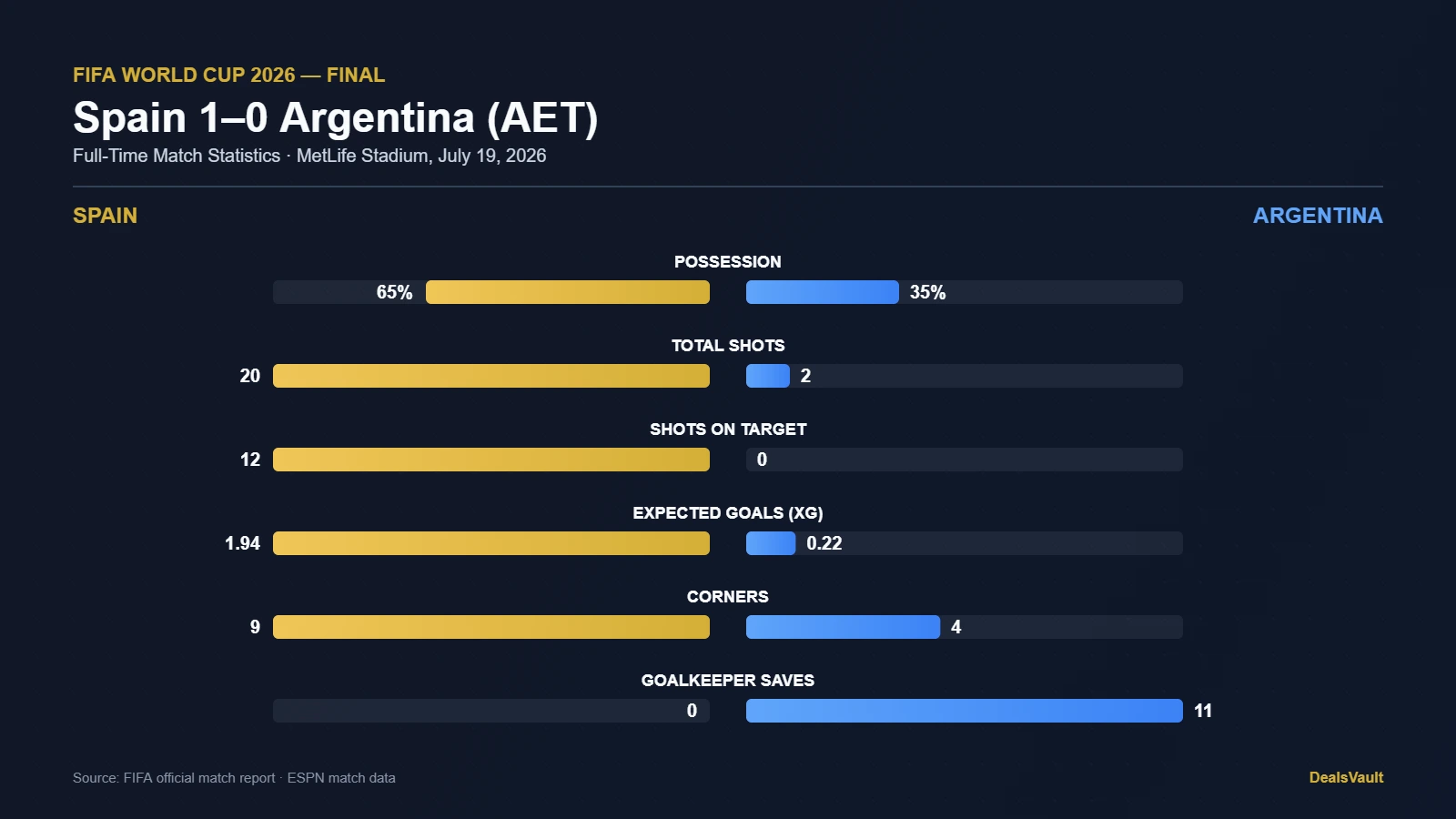
The published full-time statistics tell the story of one of the most one-sided finals in World Cup history. The figures below are drawn from ESPN's full-time match data, cross-checked against FIFA's official match report, which carries the complete statistical record. We have not reproduced full foul and disciplinary counts where an exact figure was not published in match coverage.
| Statistic | Spain | Argentina |
|---|---|---|
| Goals | 1 (Torres 106') | 0 |
| Possession | 65% | 35% |
| Total shots | 20 | 2 |
| Shots on target | 12 | 0 |
| Expected goals (xG) | 1.94 | 0.22 |
| Corners | 9 | 4 |
| Goalkeeper saves | 0 (Simón) | 11 (Martínez — men's final record) |
| Red cards | 0 | 1 (Fernández, two yellows) |
| First shot of the match | First half | 117th minute |
Possession Analysis
Spain finished with 65 percent of the ball across 120 minutes, and the halftime snapshot was even more lopsided: 35 percent for Argentina with a Spanish pass-completion rate around 90 percent. But raw possession undersells what Spain did with it. This was not sterile circulation. Pau Cubarsí alone completed 121 passes from central defense, per NBC Sports — a volume that turned Spain's back line into the launchpad for wave after wave of pressure while simultaneously denying Argentina the transitions Messi's game depends on.
Possession, in this final, was defense and attack at once. Argentina's two most dangerous players — Messi and Lautaro Martínez — cannot hurt you without the ball. For 120 minutes, they almost never had it in areas that mattered: two touches in Spain's box through halftime of extra time.
Expected Goals (xG)
Per ESPN's full-time data, Spain generated 1.94 xG from their 20 attempts against Argentina's 0.22 from two. Read that alongside the eleven saves from Emiliano Martínez and the verdict is clear: the 1-0 scoreline flattered Argentina, and only their goalkeeper's record-setting night kept the final goalless into extra time. On chance quality alone, Spain were worth roughly two goals; Argentina were worth roughly none.
Starting XIs, Substitutions and Player Ratings
Spain's Starting XI (4-3-3)
De la Fuente kept faith with the side that beat France, per ESPN's coverage: Unai Simón in goal; a back four of Pedro Porro, Pau Cubarsí, Aymeric Laporte and Marc Cucurella; Rodri and Fabián Ruiz with Dani Olmo in midfield; and a front three of Lamine Yamal, Mikel Oyarzabal and Álex Baena. Pedri, once again, began on the bench — De la Fuente preferring Ruiz's profile, a selection that had raised eyebrows all tournament.
Argentina's Starting XI
Scaloni made three changes from the semifinal win over England, restoring Rodrigo De Paul, Nico González and Gonzalo Montiel in place of Giuliano Simeone, Leandro Paredes and Nahuel Molina. Eight of Argentina's starters had also begun the 2022 final against France — experience Scaloni bet on, with veteran Otamendi initially named among the substitutes.
The Substitutions That Decided It
Every meaningful swing in this final traced back to the benches. Scaloni's changes were reactive: Paredes on for González after the break, Molina on for Montiel because Porro was overrunning that flank. De la Fuente's were proactive: the 62nd-minute removal of his top scorer Oyarzabal for fresh legs, Ferran Torres among them; Pedri slotting seamlessly into Ruiz's role, his dribbling helping Spain drive forward in extra time; and Nico Williams arriving to stretch a tiring ten-man defense — scoring a disallowed goal, then heading the assist for the winner.
A substitute assisting a substitute for the World Cup-winning goal. That is squad depth as a weapon, and it was no accident — Merino had already won two knockout rounds off the bench.
Player Ratings From the Press Box
ESPN's post-match ratings crowned the architects: Luis de la Fuente was awarded a 9 for completely shutting down Argentina's attack, and Ferran Torres an 8 for a stunning extra-time finish taken on his weaker foot. Yamal and Pedri each earned a 7 — ESPN noting Yamal didn't quite light up the final as expected but remained a constant threat against Nicolás Tagliafico's aggressive marking — with Baena and Oyarzabal on 6.
NBC Sports handed Porro a 7 for owning the right side, Cubarsí a 7 for his 121 completed passes, and Simón a 6 with the wry observation that he never had to make a save — the best seat in the house for a World Cup final. LiveScore rated Torres at 8.5 as man of the moment and Martínez at 8.2, the rare losing goalkeeper to emerge with his reputation enhanced.
At the other end of the scale, ESPN gave Messi a 3 — a sad number for a sad night, one shot in 120 minutes in what he had said would be his final World Cup.

Tactical Breakdown: Why Spain Became World Champions
Spain's Approach: Possession as a Cage
De la Fuente's game plan attacked Argentina's greatest strength — their transitions. Rodri sat as the screen in front of the back line, and his positioning did double duty: recycling possession and occupying the zones between the lines where Messi operates. Baena drifted infield from the left to create a midfield overload, freeing Cucurella to provide the width, while Porro pushed so high on the right that Argentina eventually changed their left side to cope.
The result was a cage. Argentina could not press eleven players who never gave the ball away, and could not counter without winning it. Spain's 20 shots came from patient overloads, not risk — which is also why they conceded nothing.
Argentina's Approach: Survive, Then Strike
Scaloni's plan was honest about the matchup. Argentina sat deep, protected the box, and trusted Martínez behind them, aiming to keep the game alive long enough for one Messi moment, a set piece, or penalties. For 90 minutes it worked defensively — every cross met a shin or a head, and Martínez repelled everything on target.
The flaw was that the out-ball never functioned. Zero regulation shots is not a plan surviving; it is a plan with no second act. When Fernández's red card removed even the theoretical counter-threat, Argentina's remaining path to the trophy narrowed to a penalty shootout — and Torres closed it.
The Turning Points
Three moments decided the world title. Martínez's save from Yamal's late free kick, which forced extra time and briefly made an Argentine miracle plausible. Fernández's second yellow moments later, which handed Spain a 30-minute power play. And De la Fuente's substitutions, which meant the freshest attackers on the pitch in minute 106 were both Spanish — Williams to head the cross, Torres to bury it.
Strip away the drama and the conclusion is simple. Spain won the World Cup because they controlled every phase of the biggest match: the ball, the territory, the tempo, the bench. Argentina brought heart, a heroic goalkeeper and their greatest-ever player. Spain brought a system — and the system won.


Spain's Complete Tournament Statistics
Eight matches. Seven wins. One draw. No defeats. Spain's aggregate numbers read like a training-ground exercise, and the defensive column is the one historians will keep returning to: a single goal conceded across an entire World Cup.
| Category | Figure |
|---|---|
| Matches played | 8 |
| Wins | 7 |
| Draws | 1 (0-0 vs Cape Verde) |
| Losses | 0 |
| Goals scored | 14 |
| Goals conceded | 1 (De Ketelaere, Belgium, quarterfinal) |
| Clean sheets | 7 (a World Cup record for one tournament) |
| Top scorer | Mikel Oyarzabal (5 goals) |
| Red cards | 0 in the final; Spain's title run was defined by discipline throughout |
On the ball, the pattern never wavered: Spain dominated possession in every published match report of their campaign, peaking at 65 percent in the final and 61 percent against Belgium per FIFA's official match statistics. Full tournament-wide passing-accuracy and foul aggregates are held on FIFA's official statistics platform; where an exact cumulative figure has not been published in match coverage, we have not estimated one.
The defensive record deserves its own paragraph. Simón's seven clean sheets in a single World Cup had never been done. The one goal conceded came from a rebound situation in the 41st minute of the quarterfinal — and Spain responded by winning that match anyway, then shutting out France and Argentina across their final 200-plus minutes of the tournament.

FIFA World Cup 2026 Awards: A Spanish Sweep
The individual honors, announced by FIFA after the final, confirmed what the trophy already said. Three of the four major awards went to Spanish players — and the fourth crowned a historic first.
| Award | Winner | Details |
|---|---|---|
| Golden Ball (best player) | Rodri (Spain) | Voted by FIFA's Technical Study Group; Silver Ball: Lionel Messi, Bronze Ball: Kylian Mbappé |
| Golden Boot (top scorer) | Kylian Mbappé (France) | 10 goals and 4 assists; first player ever to win the Golden Boot twice. Silver: Messi (8 goals, 4 assists), Bronze: Jude Bellingham (7 goals) |
| Golden Glove (best goalkeeper) | Unai Simón (Spain) | Record 7 clean sheets, 1 goal conceded in 8 matches |
| Best Young Player | Pau Cubarsí (Spain) | The 19-year-old center-back edged out teammate Lamine Yamal |
Rodri's Golden Ball carried weight beyond the tournament. Less than two years after rupturing his ACL, the Spain captain added the World Cup's top individual honor to his Euro 2024 best-player award and 2024 Ballon d'Or — recognition that control, not chaos, decided this World Cup. Messi, one of the few players ever to win multiple Golden Balls, had been the favorite before the final; his blank night in East Rutherford settled the vote. Mbappé's Golden Boot, by contrast, came from a France side that finished fourth — a reminder that the tournament's top scorer and its champion are rarely the same story.
Note on the FIFA Fair Play Award: at the time of writing, the winner had not been confirmed in the tournament coverage we reviewed, and it remains officially unconfirmed. We will update this section when FIFA's announcement is verified rather than speculate.

Records Broken at the 2026 World Cup
Some tournaments produce one record. This one rewrote a page of the book.
Team records. Spain became the first champion in World Cup history to concede just one goal across an entire winning campaign, and the first nation to hold the men's and women's World Cups simultaneously. Their run also set the record for most consecutive World Cup matches without conceding, a streak stretching back to Qatar 2022 that broke a mark shared by Italy (1990) and Switzerland (2006-10).
Goalkeeping records. Simón's seven clean sheets in one tournament surpassed anything a World Cup goalkeeper had produced before, and during the Austria match he broke Walter Zenga's 36-year-old record of 517 consecutive scoreless minutes. On the losing side, Emiliano Martínez's eleven saves were the most ever recorded in a men's World Cup final.
Individual records. Mbappé finished the tournament as the all-time World Cup top scorer, passing the previous mark, and became the first man to win two Golden Boots. France teammate Michael Olise set a World Cup record with seven assists in a single tournament, per Bleacher Report. Messi went without a goal or assist in the final for the first time in his previous twelve World Cup appearances — a streak whose ending was itself a record's footnote.
Tournament firsts. The first 48-team World Cup. The first hosted by three nations. The first with a round of 32, and the first to reach 104 matches. England's 6-4 win over France in the third-place match produced a scoreline never before seen at a World Cup, with Bukayo Saka scoring a hat-trick. And Cape Verde became the smallest nation ever to reach the knockout stage — on debut, without winning a game.
Coaching record. Luis de la Fuente became one of the oldest coaches to win a World Cup, per Yahoo Sports — a fitting note for a manager long dismissed as a federation insider rather than an elite tactician.
Spain 2010 vs Spain 2026: Two Crowns, One Idea
The symmetry is almost eerie. Both finals finished 1-0 after extra time. Both were settled by a forward's strike deep in the added period — Andrés Iniesta in the 116th minute against the Netherlands, Ferran Torres in the 106th against Argentina. Both teams arrived as European champions. But the two sides won in meaningfully different ways.
| Category | Spain 2010 (South Africa) | Spain 2026 (North America) |
|---|---|---|
| Coach | Vicente del Bosque | Luis de la Fuente |
| Captain | Iker Casillas (goalkeeper) | Rodri (midfielder, Golden Ball winner) |
| Base formation | 4-2-3-1 / 4-3-3 | 4-3-3 |
| Playing style | Tiki-taka: short passing, positional patience | Evolved possession: positional play plus vertical wingers, attacking full-backs and game-changing substitutes |
| Record | 6 wins, 1 loss (7 matches) | 7 wins, 1 draw, 0 losses (8 matches) |
| Goals scored | 8 — fewest ever by a champion | 14 |
| Goals conceded | 2 | 1 — fewest ever by a champion |
| Final | 1-0 aet vs Netherlands (Iniesta 116') | 1-0 aet vs Argentina (Torres 106') |
| Key players | Xavi, Iniesta, Villa, Casillas, Puyol | Rodri, Yamal, Oyarzabal, Simón, Cubarsí |
| Squad depth | Settled XI; bench rarely decisive | Bench decided matches: Merino, Torres, Williams, Pedri |
| Legacy | Completed the 2008-2012 golden era treble | Sealed the Euro 2024-World Cup double; first nation holding both World Cups |
The tactical evolution matters. The 2010 side won every knockout match 1-0 through suffocating patience. The 2026 team kept the DNA — possession as defense — but added speed at the edges and, crucially, weaponized the bench. Del Bosque's champions wore opponents down with the same eleven ideas; De la Fuente's wore them down and then sent on fresh ones.

The Legacy of Spain's 2026 Triumph
Great victories echo. This one will echo in at least four directions.
For Spanish football, the title confirms a production line, not a moment. The federation's youth structures delivered a 19-year-old Best Young Player in Cubarsí and a generational winger in Yamal, while the women's program holds its own world title and number-one ranking. No footballing nation has ever held this much silverware at once, and the pipeline behind it shows no sign of slowing.
For international reputation, De la Fuente's rehabilitation is complete. Written off at his appointment, he now owns the Euro 2024 and World Cup double, and his tournament-management template — surprise starters, ruthless substitutions, top scorers withdrawn on principle when the game demands it — will be studied by every national coach preparing for 2030.
For tactics, 2026 answered a running argument. In an era dominated by transition football and direct wingers, the most controlled team in the world won the biggest prize while conceding once. Expect a generation of coaches to re-embrace possession — not as aesthetics, but as the defensive weapon Spain proved it to be.
For history, this tournament closed the Messi and Ronaldo era at the World Cup in the same fortnight it introduced its successors. Spain's average-age advantage over every rival in the final rounds suggests this is a beginning. The 2030 World Cup — hosted by Morocco, Portugal and Spain themselves, with centenary matches in South America — will kick off with La Roja as defending champions on home soil. Few dynasties have been handed a better stage in the 96-year history of the FIFA World Cup.

Interesting Facts About the FIFA World Cup 2026 Champions
Sixteen details worth remembering from Spain's summer:
- Spain and Argentina had met only once before at a World Cup — a 2-1 Argentina win in 1966, sixty years before this final.
- Both of Spain's World Cup-winning finals finished 1-0 after extra time, with the winner scored in the second period of extra time.
- Spain's 3-0 win over Austria was their first World Cup knockout victory since the 2010 final itself.
- Mikel Merino scored match-winning goals in consecutive knockout rounds — both within minutes of coming off the bench.
- Argentina did not attempt a shot in the final until the 117th minute.
- Unai Simón never had to make a save in the World Cup final.
- Ferran Torres scored the winner with his weaker foot — and had assisted Merino's winner against Portugal earlier in the tournament.
- Pau Cubarsí completed 121 passes in the final, per NBC Sports, more than many teams manage collectively in a knockout tie.
- The halftime break stretched to 27 minutes for a show featuring Shakira, Madonna, BTS, Justin Bieber and Burna Boy, curated by Coldplay's Chris Martin.
- Spain knocked out Cristiano Ronaldo's Portugal and beat Lionel Messi's Argentina in the same tournament — likely both legends' final World Cup matches.
- Mbappé's ten goals came for a France side that finished fourth; he ended the tournament as the World Cup's all-time leading scorer.
- England's 6-4 win over France for third place was the first 6-4 scoreline in World Cup history, featuring a Bukayo Saka hat-trick.
- Argentina were attempting to become the first side since Brazil in 1962 to retain the World Cup, and to win a fourth consecutive major tournament.
- Cape Verde reached the knockout stage on debut without winning a match — three draws made them the smallest nation ever to do so.
- All three host nations were eliminated on the same round, the round of 16.
- Rodri's Golden Ball came less than two years after he ruptured his ACL.
Frequently Asked Questions About the FIFA World Cup 2026 Champions
Who won the FIFA World Cup 2026?
Spain won the FIFA World Cup 2026, defeating Argentina 1-0 after extra time in the final at MetLife Stadium in East Rutherford, New Jersey, on July 19, 2026. Ferran Torres scored the only goal in the 106th minute. It is Spain's second world title, following their first triumph in South Africa in 2010, and it completed a double with their Euro 2024 crown.
What was the score in the World Cup 2026 final?
The final finished Spain 1-0 Argentina after extra time. The match was goalless through 90 minutes, largely because Argentina goalkeeper Emiliano Martínez made a record eleven saves. Substitute Ferran Torres broke the deadlock in the 106th minute, finishing a headed assist from fellow substitute Nico Williams, and Spain controlled the closing stages to seal the title.
Who scored the winning goal in the 2026 World Cup final?
Ferran Torres scored the winning goal in the 106th minute of extra time. The forward, introduced as a substitute in the second half, met Nico Williams's headed pass and drove a powerful finish past Emiliano Martínez on his weaker foot. It was the decisive moment of a final in which Spain out-shot Argentina 20-2.
Where was the World Cup 2026 final played?
The final was played at MetLife Stadium in East Rutherford, New Jersey — branded New York New Jersey Stadium for the tournament — in front of a crowd of more than 80,000 on Sunday, July 19, 2026. It was the closing match of the first World Cup co-hosted by three nations: the United States, Mexico and Canada.
Who won the Golden Ball at the 2026 World Cup?
Spain captain Rodri won the Golden Ball as the tournament's best player, chosen by FIFA's Technical Study Group. Lionel Messi took the Silver Ball and Kylian Mbappé the Bronze. Rodri's award recognized his control of Spain's midfield throughout the tournament and capped his comeback from a serious knee injury, adding to his 2024 Ballon d'Or.
Who won the Golden Boot at the 2026 World Cup?
Kylian Mbappé won the Golden Boot with 10 goals and four assists, despite France finishing fourth. He became the first player ever to win the award at two World Cups, having also topped the scoring charts in Qatar 2022. Lionel Messi took the Silver Boot with eight goals, and Jude Bellingham the Bronze with seven.
Who won the Golden Glove at the 2026 World Cup?
Spain's Unai Simón won the Golden Glove as the tournament's best goalkeeper. He conceded just one goal in eight matches and kept a record seven clean sheets, including shutouts against Portugal, France and Argentina in the knockout rounds. Remarkably, he did not have to make a single save in the final itself.
Who was named Best Young Player of the 2026 World Cup?
Pau Cubarsí, Spain's 19-year-old center-back, won the Best Young Player award, edging out his teammate Lamine Yamal. Cubarsí started every match of Spain's campaign, anchored the meanest defense in World Cup history, and completed 121 passes in the final alone, per NBC Sports — an extraordinary tournament for a teenager.
How many goals did Spain concede at the 2026 World Cup?
Spain conceded exactly one goal in eight matches — Charles De Ketelaere's 41st-minute equalizer for Belgium in the quarterfinal. No World Cup champion had ever conceded so few across a winning campaign. Spain also set the record for most consecutive World Cup matches without conceding, a run stretching back to the 2022 tournament in Qatar.
Who did Spain beat on their way to the 2026 title?
Spain topped Group H ahead of Cape Verde, Uruguay and Saudi Arabia, then beat Austria 3-0 in the round of 32, Portugal 1-0 in the round of 16, Belgium 2-1 in the quarterfinal, France 2-0 in the semifinal, and Argentina 1-0 after extra time in the final — five knockout wins over five former World Cup or European finalists' pedigree nations.
Was this Lionel Messi's last World Cup?
Messi, 39, had indicated before the tournament that 2026 would be his final World Cup, and coach Lionel Scaloni declined to confirm his future when asked before the final. Messi finished with eight goals and four assists, won the Silver Ball and Silver Boot, but ended the final without a goal or assist for the first time in his previous twelve World Cup matches.
Why was Enzo Fernández sent off in the final?
Fernández received a first yellow card for dissent, then a second late in second-half stoppage time for a reckless challenge on Pau Cubarsí, leaving Argentina to play the entire 30 minutes of extra time with ten men. The decision generated debate, but it proved pivotal: Spain's winner came against a tiring ten-man defense in the 106th minute.
What record did Emiliano Martínez set in the final?
Martínez made eleven saves — the most ever recorded in a men's World Cup final. His performance kept a goalless scoreline through 90 minutes despite Spain registering twelve shots on target across the match, and included a decisive stop from a late Lamine Yamal free kick. He was one of the few Argentines to enhance his reputation on the night.
Who is Spain's coach, and what did he achieve?
Luis de la Fuente coached Spain to the 2026 World Cup, adding it to the Euro 2024 title for a rare international double. Per Yahoo Sports, he became one of the oldest coaches to win a World Cup. His tournament was defined by bold selection calls — Fabián Ruiz preferred to Pedri, top scorer Oyarzabal substituted in the final — all of which were vindicated.
Who captained Spain at the 2026 World Cup?
Rodri captained Spain throughout the tournament and lifted the trophy at MetLife Stadium. The Manchester City midfielder anchored the team's possession game, screened the defense against Messi in the final, and became one of the few players to win the World Cup, the European Championship, the Golden Ball and the Ballon d'Or across a single career arc.
What historic first did Spain achieve with this title?
Spain became the first nation in football history to hold the men's and women's World Cups simultaneously. The Spanish women won their World Cup in 2023 and remain the top-ranked side in the world, while the men now hold both the European Championship and the World Cup — an unprecedented concentration of major international titles for one federation.
How many teams played at the 2026 World Cup?
The 2026 tournament was the first FIFA World Cup with 48 teams, expanded from the 32-team format used since 1998. Twelve groups of four produced a new round of 32, and the tournament ran to 104 matches — the most ever. Champions Spain had to win five knockout rounds, one more than any previous World Cup winner.
Who hosted the 2026 World Cup?
The United States, Mexico and Canada co-hosted, the first three-nation World Cup, with matches spread across sixteen cities. All three hosts reached the round of 16 and all three were eliminated there — Canada by Morocco, Mexico by England, and the United States by Belgium — while the final was staged at MetLife Stadium near New York.
Who finished third at the 2026 World Cup?
England beat France 6-4 in the third-place match in Miami — the first 6-4 scoreline in World Cup history, with Bukayo Saka scoring a hat-trick. Kylian Mbappé scored twice in defeat, sealing the Golden Boot and confirming his place as the World Cup's all-time leading scorer.
When and where is the next World Cup?
The 2030 FIFA World Cup will be hosted by Morocco, Portugal and Spain, with three centenary celebration matches staged in South America to mark 100 years since the first World Cup in Uruguay. That means Spain will begin their title defense as co-hosts — the first time a defending champion has opened a World Cup on home soil since France in 1998.
Conclusion: Why Spain 2026 Will Be Remembered
Every World Cup winner gets a line in the record books. Only a few get an argument named after them. Spain 2026 will be one of the few.
The argument is about what wins football matches at the highest level. For a decade, the sport drifted toward transition — win the ball, run, strike before the opponent resets. Spain walked into the first 48-team World Cup, against the deepest field ever assembled, and won it by doing the opposite: holding the ball so completely that seven opponents in eight matches never scored, and the eighth scored once. They didn't outrun the world. They out-thought it, out-passed it, and — through Merino, Torres and Williams — out-substituted it.
That is why this title matters beyond the trophy cabinet. The 2010 side proved possession could win a World Cup. The 2026 side proved it could win the modern one — bigger, faster, longer, five knockout rounds deep — and do it with the meanest defensive record in the tournament's history. When coaches in 2030 and beyond argue about how football should be played, this campaign is now the exhibit both sides must address.
It matters for its symmetry, too. A tournament that opened with Spain failing to score against the smallest debutant in World Cup history closed with the same team suffocating the reigning champions and the greatest player of his era. Messi and Ronaldo left the World Cup stage in the same fortnight that Yamal and Cubarsí announced themselves as its future — and that future wears red.
And it matters for what comes next. Spain hold the men's World Cup, the women's World Cup and the European Championship at once, something no federation has ever done. In four years they will defend the title partly at home. Dynasties are declared too easily in football, so we will settle for the facts: the best team won, they won it their way, and everyone else now has four years to work out an answer.
Sixteen years between stars on the shirt. On the evidence of this summer, the third may not take as long.